Why your print quote looks four times too expensive
The number in your head is usually priced off a different job. What actually drives an offset quote, and a way to test whether your number was ever real.
A call this week went like this: a few hundred offset brochures, folded, full colour, and a budget that would barely have covered a tenth of that run digitally. We came back with a real number. It landed nowhere near the one they had, the conversation ended there, and it happens often enough that it is worth writing down properly instead of just explaining it again on the next call.
The gap is rarely because someone is trying to lowball. It is almost always because the number in their head was priced off a different job — usually without them realising it — and once you see why, both the shock and the actual quote stop being mysterious.
The number in your head came from somewhere else
Nobody invents a print budget from nothing. It comes from a number that stuck — a quote from years ago, a friend’s flyer run, a figure a supplier once mentioned. The trouble is that “printing” is not one price, and the number that stuck was almost never for the job actually being asked for now.
The usual mismatches:
- A vastly bigger quantity. A per-piece price that was real at 5,000 units gets remembered as the per-piece price, then applied to 500 — where it is nowhere close to real, for reasons below.
- A different process. Digital and offset are genuinely different technologies with different cost shapes, not two tiers of the same thing.
- A different spec. Single-sided versus double, thin stock versus board, no lamination versus spot UV. Each of those alone can double a price; several stacked together compound.
None of this is obvious from outside the industry, and there is no reason it should be — it is not your job to already know it. But it is why the same word, “brochure,” can honestly mean a 15-rupee job and a 150-rupee job depending on what is actually being specified.
Why offset has a floor that does not move with quantity
This is the one that catches people hardest, because it runs backwards from normal shopping intuition — usually more units means a lower price per unit, smoothly. Offset does not work smoothly.
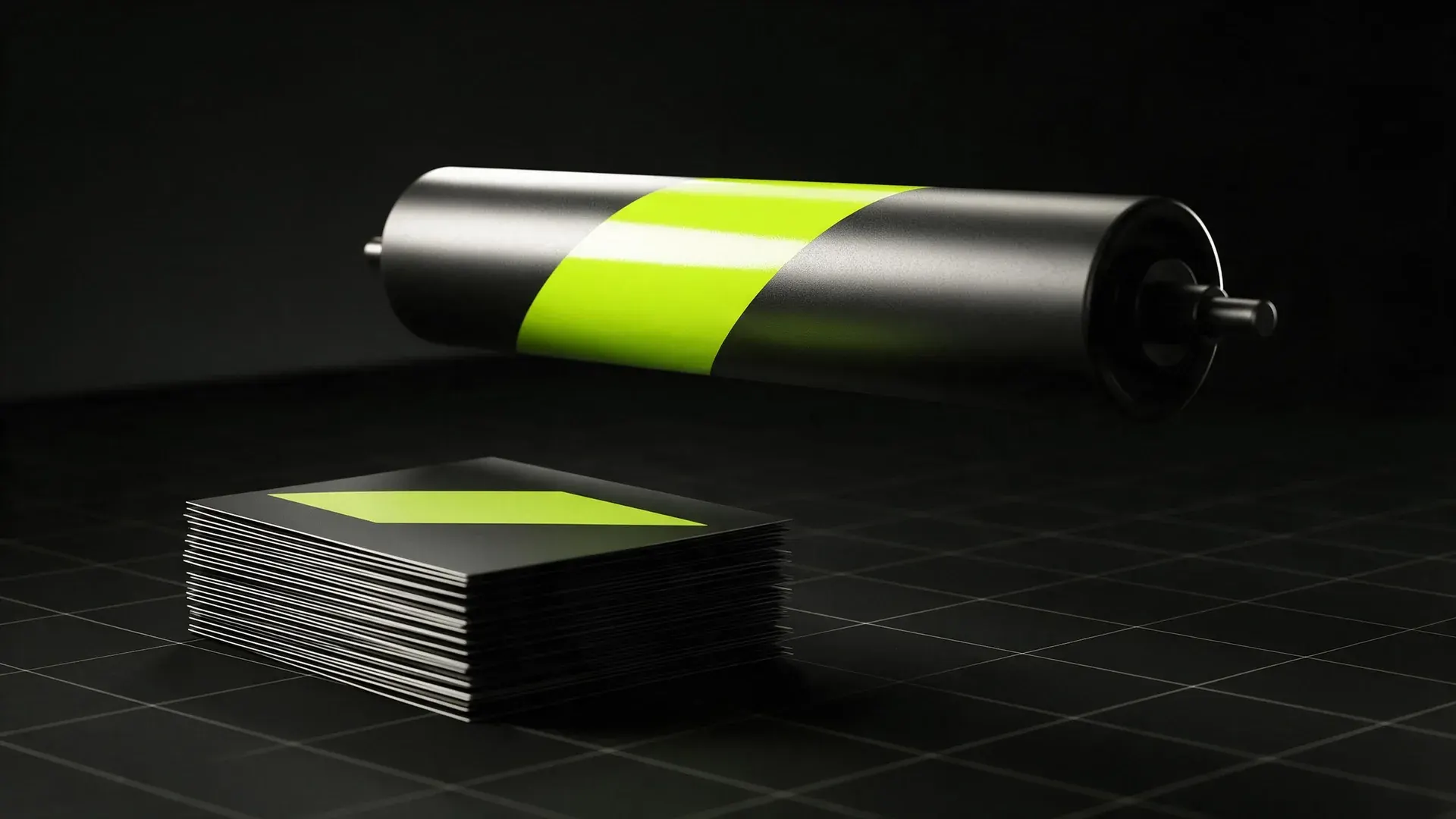
Before a single sheet prints, offset requires plates — physically, one per colour, per side — and a press makeready, the setup and calibration before the run starts. That cost is fixed. It is the same whether the run is 300 pieces or 3,000.
Which means the real shape of an offset job is:
total cost ≈ (fixed setup cost) + (cost per sheet × quantity)
At a large quantity, the fixed part gets divided across so many pieces that it nearly disappears from the per-piece price — which is exactly the number that tends to stick in memory, because it’s the impressively cheap one someone quotes when talking about a big run. At a few hundred pieces, that same fixed cost is divided across far fewer units, so it dominates the per-piece price instead of vanishing into it. The per-piece price genuinely is not the same job at two different sizes — it is closer to two different pricing regimes wearing the same name.
This is also why halving the quantity does not come close to halving the price, and why doubling it can cost surprisingly little more — the fixed part was already paid.
A way to actually test the number, without a table of prices
We are not going to hand over a chart of “printing costs X per piece,” because it would be wrong within a season — paper prices move, and a real number depends on stock, finish and exact spec. But there is a test that needs none of that.
Take the number you have in your head, and ask what quantity and spec would make it real.
If your remembered price was for 5,000 flyers, single-sided, thin stock — ask what 5,000 of that exact spec costs today, from the same or a different printer. If it lands close to what you remembered, the number was real, just for a different job than the one you actually need. If a printer’s quote for your actual job — smaller run, heavier stock, double-sided, folded — comes in several times higher, that is not a sign you are being overcharged. It is the fixed-cost floor described above, showing up exactly where the mechanism above predicts it will.
This also flags the opposite problem before it costs you money: a “cheap” quote that never explains what changed to make your job hit someone else’s remembered price. If a printer matches a number that should not be possible for your spec, the stock, colour accuracy or finish is usually what quietly gave.
What to do with this before you ask for a quote
Two things, both cheap, both from the same logic:
- Write your actual spec down first — quantity, size, pages, colour, finish, binding — before comparing it to any number you’re carrying around. The list in how to brief a printer is exactly this, and it exists because a spec written down is what turns a mismatched expectation into a real, comparable quote.
- Ask for the price at your number and at a bigger one. If your quantity is small enough that the fixed cost dominates, the quote at 2–3× your quantity will often be surprisingly close in total price — which tells you plainly whether you’re paying mostly for setup or mostly for paper, and whether ordering a bit more now is actually the cheaper move.
If the number that comes back still doesn’t make sense once you’ve done that, ask the printer to walk the quote through those two buckets — setup and per-sheet — rather than accepting a single opaque figure. A quote that can’t be broken down that way is harder to trust, and a printer who can’t break it down that way is worth being cautious of.
We quote printing jobs against the actual spec, broken into what the setup costs and what the run costs, specifically so a number that looks wrong has somewhere to be checked rather than just believed or walked away from.
Written by Ahsan “Max” Faraz, Maxverse Lab — Karachi